
A diff is a proposal written in the language of text edits. It tells you, exactly and completely, what the author changed. It cannot tell you what the change **did**.
So a reviewer infers. You read let contribution = (i as Field) * x;, you build a model of the loop in your head, you decide the arithmetic comes out right, and you approve. Only the first of those steps is evidence. The rest is a simulation you ran in your head against a program you have not seen run — and it is where review defects come from.
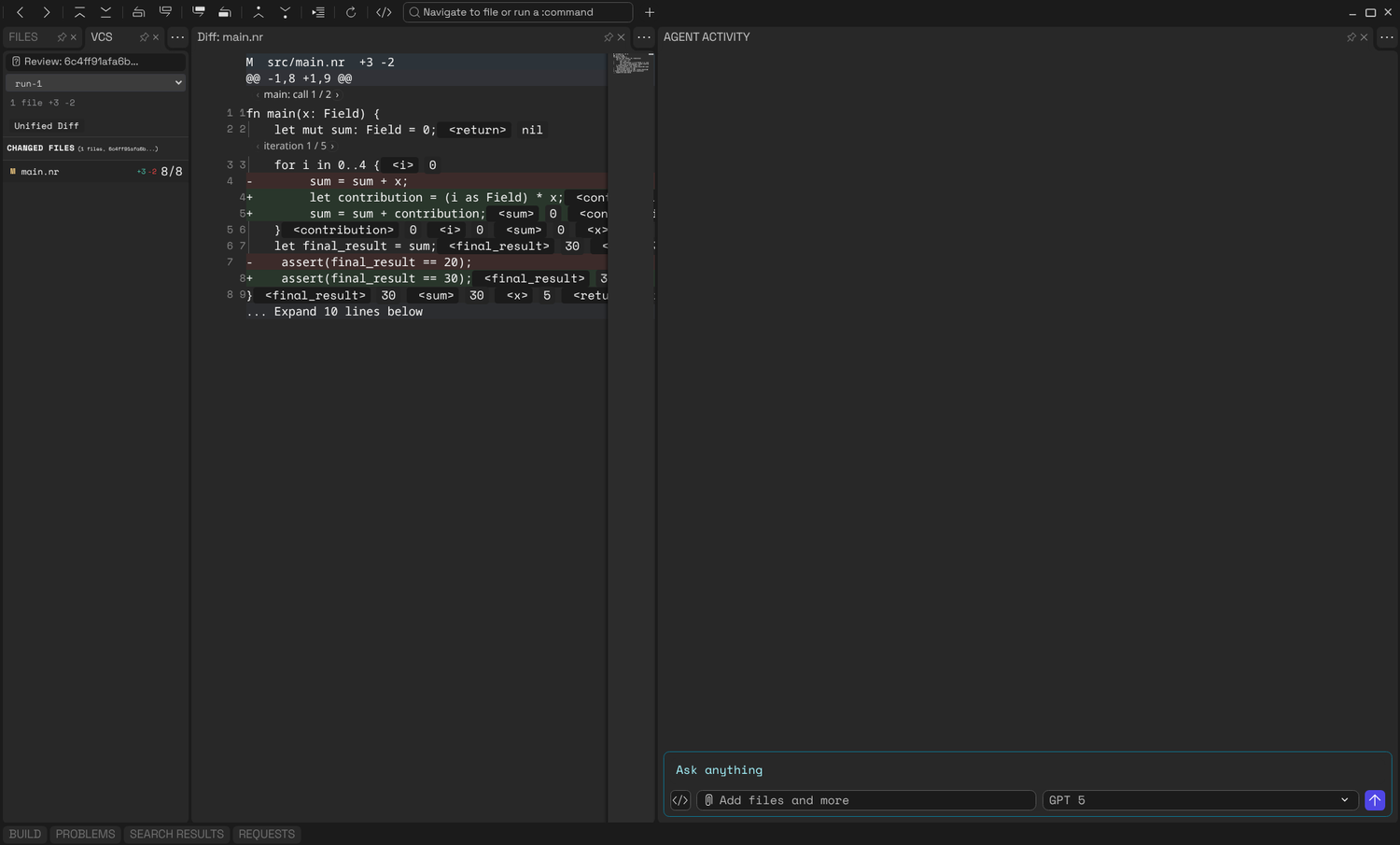
**DeepReview is code review with the recordings attached.** You give CodeTracer a diff together with one or more recordings of that code actually running, and it renders the diff with what each changed line did: which lines the run executed, how many times, and which values they held on each pass through a loop.
The questions it lets you answer
Each of these is a question about a change that a diff cannot answer at all, and that a reviewer otherwise answers by inference, by asking the author, or by checking the branch out and running it themselves.
**Did this line run at all?** Every line inside a recorded function is shaded executed or not executed, on the diff itself. A hunk that no recording ever entered looks different from one that ran on every pass, so "this branch is never taken in practice" stops being a suspicion and becomes something you can see.
**What value did it hold — on which pass through the loop?** Executed lines carry inline value chips, and a loop the recording entered gets an iteration stepper above it. Stepping it walks the same line through the values it actually held: contribution through 0, 5, 10, 15, and sum through their running total. You are reading measurements, not re-deriving them.
**Was this function called once, or forty times?** A recorded function carries an invocation stepper (‹ main: call 1 / 2 ›), and the file rows carry coverage counts. A helper the change touched lightly and a helper it put on a hot path are different reviews, and the dataset already knows which one you are looking at.
**Which parts of the change did the runs never exercise?** The same shading, read the other way. It is the honest version of "is this tested?" — not a promise that the untouched lines are wrong, but a list of the ones no recording has anything to say about.
**What did the agent that produced this change actually do?** When a review is collected inside an agent session, the Agent Activity panel shows that session's conversation, loaded by reference against the agent backend. The change, the evidence for it, and the reasoning that produced it are in one window.
What a review actually is
Two commands and one artefact:
ct review collect …   # build a review dataset from recordings + a diff
ct review <PATH>      # open it
A **review dataset** is a self-contained review.json: the diff, the source of each changed file, per-line coverage, the recorded flow (steps and values), and the call tree. It is produced once and can be opened later, on another machine, without the original recordings — which is what makes a review something you can hand to somebody rather than a session you have to be present for.
DeepReview adds **no panel of its own**. A review routes its data into three panels CodeTracer already has — the VCS panel, the Editor, and the Agent Activity panel — and leaves your layout otherwise alone. Everything you already know about the editor still applies inside a review.
What it does not tell you
Worth stating in the same breath, because a tool that shows execution next to a diff invites a stronger reading than it has earned:
- **It does not tell you the change is correct.** It tells you what happened in
the runs you recorded. Judging whether that is what *should* have happened is still the review.
- **It is not a test report.** A review dataset carries no test results at all —
no names, no statuses, no durations — so no surface reports them, and none shows a zero in their place. ct test is a separate command, and issues **no test certificates** — see Not yet available for exactly how far it goes. Nothing in a review claims otherwise.
- **Coverage is observation, never reachability.** A recording can say a line
was not observed. It can never say a line cannot be reached, and a review does not pretend the two are the same.
- **It reviews the changed code, not everything it calls.** Flow is collected for
the functions the diff touched; a callee gets a call count and coverage, but no overlay of its own.
The full list of the things that are deliberately not there yet lives on Not yet available. It is worth a read before your first review: everything on it is real behaviour you will meet, written down so you do not read it as a bug or, worse, as a measurement.
Where to go next
- Collecting a review — the two commands, a worked
example end to end, and what happens with native (rr) recordings.
- Reading a review — the three panels, the flow overlay
and the steppers.
- The agent workflow — how an agent produces a
review, and how to make it do so reliably.
- Not yet available — the deferrals, named.